Publications
Full list also available on Google Scholar.
Selected journal articles
 Temporal adjustment approach for high-resolution continental-scale modeling of soil organic carbon
Bokati L., Somenahally A.C., Kumar S., Perepi R., Sarkar R., Talchabhadel R., Robatjazi J.
Scientific Reports, 2025, Vol. 15, Art. 6483.
A proximity-based, distance-matrix temporal adjustment framework that harmonizes legacy SOC observations to a single reference year, used with CatBoost to produce continental-scale baseline SOC maps for CONUS.
 Soil Carbon Modeling at Crossroads: Building Reliable Methods for Policy and Practice
Bokati L., Kumar S., Somenahally A.C.
European Journal of Soil Science, 2026, Vol. 77, No. 2, Art. e70295.
Methodological synthesis identifying depth autocorrelation, circular density logic, and validation gaps as recurring biases in ML soil-carbon maps, with reproducible diagnostics for policy- and practice-relevant deployment.
 Estimating soil organic carbon deficits at the continental scale using legacy-data-driven dynamic baseline and attainable projections
Somenahally A.C., Bokati L., Kumar S.
Geoderma, 2025, Vol. 462, Art. 117515.
Defines an attainable upper bound on SOC under specific climate, land-use, and soil conditions and maps continental-scale carbon deficits across CONUS croplands, pasture, and forest.
Understanding spatiotemporal variation of heatwave projections across US cities
Bhattarai S., Bokati L., Sharma S., Talchabhadel R.
Scientific Reports, 2025, Vol. 15, Art. 10643.
Quantifies compound daytime and nighttime heatwave intensity, duration, and frequency across U.S. cities under future climate scenarios to support urban resilience planning.
 Ensemble Streamflow Forecasting With Diverse Loss Functions
Dahal K., Gupta A., Bokati L., Kumar S.
Applied Soft Computing, 2026, Vol. 198, Art. 115276.
Ensemble deep-learning streamflow forecasting that combines multiple models trained with diverse loss functions to capture low, mid, and high flows in arid and semi-arid watersheds.
 Mapping Soil pH Baselines, Trends, and Time-to-Critical Crop Risk across CONUS Using Harmonized Legacy Datasets: A Large-Scale Assessment
Thai S., Somenahally A., Robatjazi J., Bokati L., Talchabhadel R., Kumar S.
Journal of Environmental Management, 2026, Vol. 404, Art. 129508.
Continental-scale mapping of baseline soil pH, recent trends, and time-to-critical-crop-risk across CONUS using harmonized legacy datasets — supporting agricultural risk assessment under changing soil conditions.
Other journal articles
A Peer-Conditioned Attainable Evapotranspiration Framework for Diagnosing Field-Scale Water-Use Efficiency
Bokati L., Shah N., Kumar S.
Manuscript in preparation.
 Why Daubechies wavelets are so successful
Ayala Cortez S., Bokati L., Velasco A., Kreinovich V.
Journal of Intelligent and Fuzzy Systems, 2022, Vol. 43, No. 6, pp. 6933–6938.
 Why Linear Expressions in Discounting and in Empathy: A Symmetry-Based Explanation
Leurcharusmee S., Bokati L., Kosheleva O., Kreinovich V.
Soft Computing, 2021.
 A New (Simplified) Derivation of Nash’s Bargaining Solution
Nguyen H.P., Bokati L., Kreinovich V.
JACIII, 2020, Vol. 24, No. 5, pp. 589–592.
How to Combine (Dis)Utilities of Different Aspects into a Single (Dis)Utility Value, and How This Is Related to Geometric Images of Happiness
Bokati L., Nguyen H.P., Kosheleva O., Kreinovich V.
JACIII, 2020, Vol. 24, No. 5, pp. 599–603.
 Common Sense Addition Explained by Hurwicz Optimism-Pessimism Criterion
Aryal B., Bokati L., Godinez K., Ibarra S., Liu H., Wang B., Kreinovich V.
Journal of Uncertain Systems, 2019, Vol. 13, No. 3, pp. 172–175.
When Revolutions Succeed? 80/20 Rule and 7 Plus Minus 2 Law Explain the 3.5% Rule
Bokati L., Kosheleva O., Kreinovich V.
Journal of Uncertain Systems, 2019, Vol. 13, No. 3, pp. 186–188.
Decision Theory Can Explain Why Buying and Selling Prices Are Different
Bokati L., Kreinovich V.
Journal of Uncertain Systems, 2019, Vol. 13, No. 3, pp. 189–192.
 Bhutan Landscape Anomaly: Possible Effect on Himalayan Economy
Nguyen T.N., Bokati L., Velasco A., Kreinovich V.
Thai Journal of Mathematics, 2019, Special Issue on Structural Change Modeling and Optimization in Econometrics, pp. 57–69.
Conference papers
 Why Exponential Almon Lag Works Well in Econometrics: An Invariance-Based Explanation
Bokati L., Kreinovich V.
Proc. 11th IEEE International Conference on Intelligent Systems IS’22, Warsaw, Poland, Oct 12–14, 2022.
Why Smaller-Size Objects Affect the Flow Much More than Larger Ones: A Geometric Explanation with Applications Ranging from Volcanoes and Tornadoes to Blood, Fish, and Building Preservation
Bokati L., Kreinovich V.
Proc. 11th IEEE International Conference on Intelligent Systems IS’22, Warsaw, Poland, Oct 12–14, 2022.
 How to elicit complex-valued fuzzy degrees
Bokati L., Kosheleva O., Kreinovich V.
Proc. NAFIPS 2022, Halifax, Nova Scotia, Canada, May 31 – June 3, 2022.
 How Much For a Set: General Case of Decision Making Under Set-Valued Uncertainty
Bokati L., Kosheleva O., Kreinovich V.
In: Rayz J., Raskin V., Dick S., Kreinovich V. (eds.), Explainable AI and Other Applications of Fuzzy Techniques (Proc. NAFIPS 2021), West Lafayette, IN, Jun 7–9, 2021. Springer, Cham, 2022, pp. 400–405.
Why Fuzzy Techniques in Explainable AI? Which Fuzzy Techniques in Explainable AI?
Cohen K., Bokati L., Ceberio M., Kosheleva O., Kreinovich V.
In: Rayz J., Raskin V., Dick S., Kreinovich V. (eds.), Explainable AI and Other Applications of Fuzzy Techniques (Proc. NAFIPS 2021). Springer, Cham, 2022, pp. 74–78.
 Scale-Invariance and Fuzzy Techniques Explain the Empirical Success of Inverse Distance Weighting and of Dual Inverse Distance Weighting in Geosciences
Bokati L., Velasco A., Kreinovich V.
Proc. NAFIPS 2020, Redmond, WA, Aug 20–22, 2020.
 It Is Important to Take All Available Information into Account When Making a Decision: Case of the Two Envelopes Problem
Bokati L., Kosheleva O., Kreinovich V.
Proc. 4th International Conference on Intelligent Decision Science IDS’2020, Istanbul, Turkey, Aug 7–8, 2020.
 Why Deep Learning Is More Efficient than Support Vector Machines, and How It Is Related to Sparsity Techniques in Signal Processing
Bokati L., Kosheleva O., Kreinovich V., Sosa A.
Proc. 2020 ISMSI’2020, Thimphu, Bhutan, Apr 18–19, 2020.
 Towards a More Efficient Representation of Functions in Quantum and Reversible Computing
Galindo O., Bokati L., Kreinovich V.
Proc. EUSFLAT’2019 / IQSA Quantum Structures Workshop, Prague, Czech Republic, Sep 9–13, 2019.
 Softmax and McFadden’s Discrete Choice under Interval (and Other) Uncertainty
Kubica B.J., Bokati L., Kosheleva O., Kreinovich V.
In: Wyrzykowski R. et al. (eds.), Proc. PPAM’2019, Bialystok, Poland, Sep 8–11, 2019. Springer, 2020, Vol. II, pp. 364–373.
Books and book chapters
 Decision Making Under Uncertainty, with a Special Emphasis on Geosciences and Education
Bokati L., Kreinovich V.
Studies in Systems, Decision and Control. Springer, Cham, 2023.
 Why Shapley Value and Its Variants Are Useful in Machine Learning (and in Other Applications)
Bokati L., Kosheleva O., Kreinovich V., Thach N.N.
In: Kreinovich V., Sriboonchitta S., Yamaka W. (eds.), Machine Learning for Econometrics and Related Topics. Springer, Cham, 2024, pp. 169–174.
A Possible Common Mechanism Behind Skew Normal Distributions in Economics and Hydraulic Fracturing-Induced Seismicity
Bokati L., Velasco A., Kreinovich V., Autchariyapanitkul K.
In: Kreinovich V., Sriboonchitta S., Yamaka W. (eds.), Machine Learning for Econometrics and Related Topics. Springer, Cham, 2024, pp. 175–179.
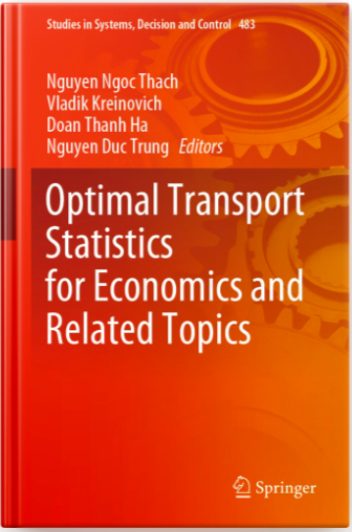 Why Quantiles Are a Good Description of Volatility in Economics: An Alternative Explanation
Bokati L., Velasco A., Kreinovich V., Autchariyapanitkul K.
In: Thach N.N., Kreinovich V., Ha D.T., Trung N.D. (eds.), Optimal Transport Statistics for Economics and Related Topics. Springer, Cham, 2023, pp. 169–173.
 Why Rectified Power (RePU) Activation Functions Are Efficient in Deep Learning: A Theoretical Explanation
Bokati L., Kreinovich V., Baca J., Rovelli N.
In: Ceberio M., Kreinovich V. (eds.), Uncertainty, Constraints, and Decision Making. Springer, Cham, 2023, pp. 7–13.
Why Rarity Score Is a Good Evaluation of a Non-Fungible Token
Bokati L., Kosheleva O., Kreinovich V.
In: Ceberio M., Kreinovich V. (eds.), Uncertainty, Constraints, and Decision Making. Springer, Cham, 2023, pp. 69–74.
Why Time Seems to Pass Slowly for Unpleasant Experiences and Quickly for Pleasant Experiences: An Explanation Based on Decision Theory
Bokati L., Kreinovich V.
In: Ceberio M., Kreinovich V. (eds.), Uncertainty, Constraints, and Decision Making. Springer, Cham, 2023, pp. 257–261.
 Why Decreased Gaps Between Brain Cells Cause Severe Headaches: A Symmetry-Based Geometric Explanation
Bokati L., Kosheleva O., Kreinovich V., Nguyen H.P.
In: Nguyen H.P., Kreinovich V. (eds.), Deep Learning and Other Soft Computing Techniques: Biomedical and Related Applications. Springer, Cham, 2023, pp. 35–38.
 Economics of Reciprocity and Temptation
Bokati L., Kosheleva O., Kreinovich V., Thach N.N.
In: Sriboonchitta S., Kreinovich V., Yamaka W. (eds.), Credible Asset Allocation, Optimal Transport Methods, and Related Topics. Springer, Cham, 2022, pp. 31–38.
Why Geometric Progression in Selecting the LASSO Parameter: A Theoretical Explanation
Kubin W., Xie Y., Bokati L., Kreinovich V., Autchariyapanitkul K.
In: Sriboonchitta S., Kreinovich V., Yamaka W. (eds.), Credible Asset Allocation, Optimal Transport Methods, and Related Topics. Springer, Cham, 2022, pp. 195–202.
 How to Make Sure That Robot’s Behavior Is Human-Like
Kreinovich V., Kosheleva O., Bokati L.
In: Wei B. (ed.), Brain and Cognitive Intelligence — Control in Robotics. CRC Press, Boca Raton, FL, 2022, pp. 70–80.
 How to Explain the Anchoring Formula in Behavioral Economics
Bokati L., Kreinovich V., Le C.V.
In: Thach N.N., Ha D.T., Trung N.D., Kreinovich V. (eds.), Prediction and Causality in Econometrics and Related Topics. Springer, Cham, 2022, pp. 28–34.
How the Proportion of People Who Agree to Perform a Task Depends on the Stimulus
Bokati L., Kreinovich V., Ha D.T.
In: Thach N.N. et al. (eds.), Prediction and Causality in Econometrics and Related Topics. Springer, Cham, 2022, pp. 22–27.
 Absence of Remotely Triggered Large Earthquakes: A Geometric Explanation
Bokati L., Velasco A., Kreinovich V.
In: Ceberio M., Kreinovich V. (eds.), How Uncertainty-Related Ideas Can Provide Theoretical Explanation for Empirical Dependencies. Springer, Cham, 2021, pp. 37–41.
How Can We Explain Different Number Systems?
Bokati L., Kosheleva O., Kreinovich V.
In: Ceberio M., Kreinovich V. (eds.), How Uncertainty-Related Ideas Can Provide Theoretical Explanation for Empirical Dependencies. Springer, Cham, 2021, pp. 21–26.
Why Immediate Repetition Is Good for Short-Term Learning Results but Bad For Long-Term Learning: Explanation Based on Decision Theory
Bokati L., Urenda J., Kosheleva O., Kreinovich V.
In: Ceberio M., Kreinovich V. (eds.), How Uncertainty-Related Ideas Can Provide Theoretical Explanation for Empirical Dependencies. Springer, Cham, 2021, pp. 27–35.
Why Gamma Distribution of Seismic Inter-Event Times: A Theoretical Explanation
Bokati L., Velasco A., Kreinovich V.
In: Ceberio M., Kreinovich V. (eds.), How Uncertainty-Related Ideas Can Provide Theoretical Explanation for Empirical Dependencies. Springer, Cham, 2021, pp. 43–50.
 We Need Fuzzy Techniques to Design Successful Human-Like Robots
Kreinovich V., Kosheleva O., Bokati L.
In: Kahraman C., Bolturk E. (eds.), Toward Humanoid Robots: The Role of Fuzzy Sets. Springer, Cham, 2021, pp. 121–131.